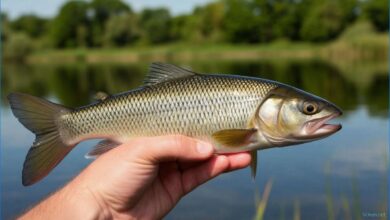
Brown trout
Storm trout is one of the most amazing representatives of the salmon family. It is a fish that can be both lake (called trout) and anadromous. It can adapt quickly to different living conditions – Migratory fish can stay in freshwater areas if there is enough food. She goes for walks in the sea. This article describes what a brown trout looks like, where it is and how to catch it.
Content of the article:
- Photo and description of bearfish
- Where lives cucumber on the Kola Peninsula
- Where to catch the cucumber
Photo and description of bearfish
Due to the fact that this species is ecologically plastic, its habitat is very large. Where is trout? First of all, these are the basins of the Barents and the White Seas. The Caspian Sea, the Aral Sea and even the Mediterranean Sea. The extreme points where saw fish – Iceland. It is interesting that in Russia brown trout is also found in Dagestan. There is a unique view, found only in Lake Eisenham.
This species has long been known to biologists, the description of the brown trout appeared in the first collection of Carl Linnaeus Systema Naturae in 1758. Europeans settled all over the world and took their offspring with them. Today, brown trout is found not only in Europe, but also in New Zealand and North America. The remarkable ability to adapt to the environment distinguishes representatives of this family of salmon. When the young brown trout falls into freshwater lakes, it can adapt and turn into an ordinary trout.
An interesting pattern is that there are more females among migratory fish and more females among freshwater fish. Men. During the spawning period – summer, especially in early autumn – brown trout comes to the river from the sea and forms large populations. The fish hatch from October to November. On average, about 2-3,000 eggs per individual.
The picture looks like this.

The most characteristic feature of her appearance are large black spots covering her entire body. Freshwater fish are silvery, marine – small pink spots on the sides. The brown trout has a large mouth with an elongated upper jaw. The scales are elongated and very dense, with a gradually decreasing tail size. In adults, the crust fins are sharply sharpened. Brown trout has fewer jaw scraps than salmon, and the first and last scraps are buffalo.
As for the size, it largely depends on where the trout is located. As such, they usually have a length of 30 to 70 cm, and their weight varies from 1 to 5 kg. However, in the Baltic Sea some fish can reach more than 1 meter in length and weigh more than 10 kg, while smaller specimens are usually found in the rivers of the Kola Peninsula. length 25-35 cm and weight 1 kg. Fish live on average 18-20 years.

Where lives cucumber on Kola peninsula
As soon as you understand what trout looks like, we can talk about where to look for it in the Murmansk region. The brown trout has the largest habitat among all the fish of the Kola Peninsula. They can be found in streams, lakes, rivers, reservoirs and the sea. Depending on the where the fish lives there are three subspecies of brown trout
- Form of passage. Such fish breed in rivers and go to the sea to gain weight;
- River trout. These fish prefer lakes. Most of the Kola Peninsula’s rivers begin at the foot of the marsh, and the fish have adapted to these conditions by making short migrations from the lake to the upper reaches of the river and back.
- Endemic species. They live in lakes without streams, falling and flowing rivers. Populations live, feed and breed in the same water bodies and can differ greatly in appearance.
They feed mostly on fish, but their menu can also include insects, frogs and even small rodents. Like most salmon fish on the Kola Peninsula, trout spawn in autumn. Depending on the location of the aquarium, the fish can already lay caviar under ice in late August and late November. During spawning trout may migrate or remain in the lake. You can catch trout in the Murmansk region almost all year round. Unlike salmon, trout continues to feed until the last moment. The break in the claw occurs only immediately after germination and does not last long.
Where to catch cucumber
Brown trout is a fish that reacts very strongly to changes in weather conditions. Changes in temperature, wind, and pressure can cause the fish to go into enclosed areas or stop feeding.
Where are you trying to catch trout? First of all, professional fishermen are advised to pay attention to splashing stones and areas where black spots are visible on the bottom. In most cases, these are holes and ditches. In rivers and lakes, the places of predator ambush are mainly hanging bushes, fallen trees, stones and areas where currents and changes in flow occur. For example, fish are usually caught where rivers flow into or out of lakes.
What do you usually fish for? Like other predatory fish, they love the natural appearance of their prey, so prey fishing is an ideal option. Make sure you have a sucker with a short handle – the fish is actively fighting, and it is almost impossible to take it with your bare hands. The brown trout breaks out and pulls to the end.
Speaking of the best bait for trout fishing, it works best in calm water. For example, fully flowing rivers and lakes – take surface flies. They “graze” – leave in the water the moustache, which is well visible from a distance of several meters. Streamers and nymphs fish in fast-flowing rivers.
If you are interested in brown trout and want to try your hand at fishing, join a fishing camp at Belushka River Lodge. It is located at the mouth of the Beloshka River, near the Volona River, one of the most famous salmon rivers of the Murmansk region. Our camp specializes in sports fishing for salmon, but trout often swims in the river. Some fishing reports contain photographs of brown trout and Atlantic salmon.
An important difference between Belousiha River Lodge and other camps is that experienced guides accompany guests daily. They will teach you about brown trout, siga, harius and salmon, pick flies and give tips on hunting for prey. Come in the summer of 2022 – for a unique experience of catching different species of salmon!