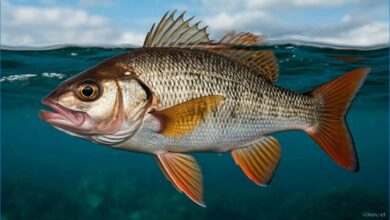
Chub
The head is an extensive medium-sized fish from the carp family. The distinctive features of the head are a large, sloping top, wide and flat forehead and head, thanks to which it received its name. The goldfish is one of the most popular fish among fishermen, for catching and turning the trough, or located on a floating rod. There are conflicting opinions about the taste of meat. Some fishermen speak of the target as an average fish with an average taste. On the contrary, the other part of the fishermen praises the head for the taste of his meat. More information about this fish is given below.
Content of the article:
- Appearance
- Age and size of head
- Relatives and head types
- Distribution
- Habitats of harius
- Head Lifestyle
- What eats head
- Head multiplication
- Enemies of the Head in Nature
- Head hunting
- Head in Culinary
Appearance
In its appearance, the head is an incredibly beautiful fish. The head has a strong, cylindrical, elongated body, slightly squeezed from the sides and smoothly tapered to the tail. The shape of the head immediately shows that he is an excellent swimmer and can successfully withstand strong currents.
The head of the head is much larger than that of most other fish living in our bodies of water. The head of the beak is slightly tilted upwards and has a wide, flat forehead. Inside the lobster head, the head got its name: head, head, head.

The heads have large shiny eyes with a yellow hue. At the top of the eye there is a brown-yellow spot.
The head has a large semi-vertical mouth with a wide cut and a slightly forward lower jaw. Lips are thick, fleshy and strong.
Instead of the last pair of bow-killing heads, as in most fish of the Carpophidae family, there is a bone plate on the inside of which are located special throat teeth. Invisible from the outside, they are involved in wrapping food. With their help, the head can wipe even the hard chitin armor of crabs and beetles.
The back and sides of the head are covered with a large scal that sits firmly on the body. The carved head has an old silver color with small golden shades. Each flap has a dark pebble that expands in front of the peel. The sides are almost straight, but there is a slight curvature in the abdomen around the head, on a scale of 44-46. The back of the head is dark, almost black, with light shades of dark green, blue and purple. The sides are silver.

The abdomen is reliably protected from damage such as chain, small, hard and tightly attached scales. Belly silver-milky color.
The spinal fin of the head has three unstressed and eight to nine branched rays, painted in the color of the spinal surface, but along the outer edge of the fin passes the darkest border.
The tail feather with cuttings is painted in the color of the back. Chest fins are orange, much lighter at the bottom. Anal and abdominal fins are bright red, dark red or brown, sometimes colorless or with dark edges and rounded borders.
Age and size of head
The average head size is usually 1-1.5 kg, and the length is 35-40 cm. In some large rivers, the Dniester, Dnieper and other large rivers, the head can reach a weight of 4 kg, and sometimes 8 kg. The length of the heads weighing 8 kg reaches 80 cm. These fish are about 20 years old. Cases of catching such fish are described in the literature.
Wood grows relatively slowly, at the age of 3 years it weighs only 150 g, at 6-7 years reaches the weight of 500 g, and at 9-10 years – 1 kg. The growth rate of the heads depends on the richness of the feed base, water temperature and light mode.
The most favorable conditions for the life of the head are in the large rivers of the southern regions, where the largest head is found. In bodies of water located at more northern latitudes, the living conditions of the heads are less favorable, and here the maximum size is much smaller.
The maximum life expectancy of the heads is about 20-25 years, although in the wild very few individuals reach such a precarious age.
Relatives and head types
The head belongs to the genus Chub, the family Carabidae, the carp family. In the genus of heads, in addition to the ordinary white head, scientists include another 52 species, all of which are found in Europe and Turkey. Most of these species have very limited habitat. Among other well-known carp fish, the nearest relatives of the head are the Ugui and the Ayede.
Some fishermen confuse an adult head with an idea. This is because they are very similar to each other, have a similar color and often live in the same areas. To distinguish between these two species, it is necessary to know the characteristics of each of them.
-
- The edges of the cross and the back fin of the tail protruding outwards and concave inwards;
The number of scales on the side line in heads 44-46, in idols 55-60;
Head with large head, wide mouth and round sides; walking with a moderately large head, narrow mouth and compressed sides;
Heads have red abdominal and anal fins, idols have orange abdominal fins.
It is more difficult to distinguish young heads from young ibises. They differ as follows
The size of the shell and the number of side line shells in ibises and tuna are very similar: from 44 to 46 in ibises and from 46 to 52 in tuna;
The edge of the crucified fin of the seafood is convex inwards, while at the heads it is convex outwards.
In addition to the ordinary head, on the territory of our country lives the white head. They live on the Caucasus River, which flows into the Azov, Black and Caspian Seas. They are especially abundant in the Terek, Kuban, Afips, Kura, Psekups, Kuma, Zolka and Podkumok rivers.
Distribution
The headache is widespread in Europe and Asia Minor. The habitats of the chub occupy a vast territory, from the Pyrenees to the Urals. In northeastern Europe, the head area reaches the Northern Twin. In Asia Minor – to the Euphrates River. The habitat of the head is limited by the coast of the Mediterranean Sea to the south and the Scandinavian Peninsula to the north. Since the golden is a very heat-loving fish, it is not found in harsh winter regions east of the Urals. The eastern borders of the Chub Mountains are the Ufa, Ural, Ilik, Chusovaya, Silva and Kosova rivers.
The headache is most common in the rivers of the Caspian, Azov and Black Sea basins. It is found in several rivers of the Baltic and White Seas. In Europe, the head lives in the Elbe, Rhine, Oder, Dniester, Dnieper, Danube and Pripyat. In Russia on the Volga, Kam, western and northern Dvina, Oke, Hopre, Vychekhda, Don, the Northern Don tributaries and main water arteries. In the Caucasus, Kubani, Tereke, Kure, etc. d. inhabits a closely related species – Caucasian head.
Places of habitat harius
The head is sensitive to water purity and oxygen saturation, so it lives in rivers with strong and medium currents. The head is not actually found in stagnant bodies of water, preferring to leave the stagnant bodies of water along the tributaries falling into them.
In plain rivers, the head is more common upstream than downstream or near the mouth. In mountain rivers, the head is more common in the middle and lower currents.
Golawl can be found in rivers where trout and harius flow, but few other animals of the carp family are found.
In the rivers, horsebacks choose areas with fast flow, hard sandy or rocky bottom, fast-growing shrubs and trees. The head avoids dirty areas.
Favourite places of Borovar on the river:
prefers to stay in places located slightly above or below it, in relatively quiet and deep places hidden behind shelters;
Crashed on a sandy, stony or simply uneven bottom;
-
- On the borders of eddy currents and backwater;
mouth of fast rivers;
- Parts of the river with trees and shrubs hanging over the water;
- Thick underwater obstacles.
The regulation of the river is dried up, and the construction of dams has a negative effect on the number of heads.
Head Lifestyle
The head is a very active and mobile fish. Young specimens are usually lost in hatcheries, and the older the age, the smaller the fish hatchery. Larger heads are held in groups of two or three fish, and the largest head leads a very solitary lifestyle.
In the cold season, the head is usually kept at the bottom, and in the warm season it is often on the surface, especially during the mass accumulation of insects. Often changes give a strong surge of presence. Young heads can jump through insects flying over water.
However, small heads are not particularly shy. As the heads grow older, their behavior changes. Adult heads are very attentive and careful fish, noticing everything that happens on the surface and on the shore. Suspecting danger, the head goes into hiding and