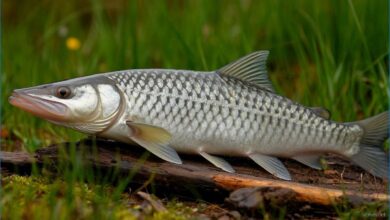
Carp fish
Many carp fish are familiar not only externally, but also to taste. It is quite large and is often a freshwater resident. Carp is beautiful, it is covered with large, gold, overflowing scales, like a knight in shining armor.
Fishermen are always happy to catch it. The life of this interesting fish is analyzed, its external features, customs, temperament and other important characteristics are studied.
Content of the article:
- Origin of species and description
- Appearance and features
- Where does the carp live?
- What does the carp eat?
- Character and lifestyle features
- Social structure and reproduction
- Natural Enemies of Carps
- Population and Status of Species
Origin of type and description

Carp is a representative of a brilliant class of fish belonging to the Carp family. Disputes about the origin of carp do not cease to this day. There are two contradictory versions.
The first of them says that the carp was bred artificially in China, and that wild carp genetics were used to breed it. Fish was considered very prestigious at the court of Chinese emperors and even among various nobility. Gradually, along river canals and with the help of carpenter sailors, it spread throughout Europe. In translation from Greek, the name “ki” means “harvest” or “fertility”. Carp, indeed, is so fertile that it was widely settled in many rivers and lakes of Europe, then it landed in Britain and was recorded on the North American continent in the 19th century.
Video: Fish Carp
The second version completely refutes the first, considering only the myth. According to her, such fish as wild carp have long been found in rivers and lakes and differ in their shape. The carp, living in running water, had an elongated torpedo-shaped body and the other was round, wide and thick. It is believed that it was settled by people in Europe, North America and Asia in lakes. Improvements in the selection of this breed began to engage in the breeding of the newest varieties and hybrids of all species for two centuries.
Based on this theory, the name “kars” has no scientific origin and appeared only in Sergei Akkov’s book on fishing in the 19th century. Thus, Bashkir is called the wild carp, which in translation from Turkish means “fish-il”, and although this name is widespread in the people, ichthyologists believe that the wild and domestic carp are the same species.

Carp is found not only in rivers and lakes (ponds), but also in individual varieties such as:
-
- Naked;
- Cheese;
- Frame;
“The mirror.
Their main characteristics are the color and location of the scale. The scaly carp is covered with scales of large size. Frames have scales only on the back and abdomen. Mirror carp carp is very large and is in place (often along the sides of the fish). The naked car has no scales at all, but is the largest in size, then mirrored in size, then scaled.
Appearance and features
Photo: Fish in the water
An ordinary carp is easily recognized by a number of parameters.
Large, thick, slightly elongated body;
Large scales, thick, with dark pebble, with 32-41 scales along the sides of the fish;
The sides of the fish are golden, slightly brown, and the thick belly has a lighter tone;
Carp – Large oral holder expanding into a tube;
The upper lip is decorated with four short lips and is very sensitive;
Fish eyes are planted high and have small pupils adjacent to the greenish-golden rainbow shell;
The spine of a powerful fish has captured fins of dark shades and grey-olive color, with short anal fins and spikes;
- Carp nostrils sink inside.
The mucus envelops the entire carp body, preventing friction, regulating body temperature and protecting it from all kinds of parasites. Carp is very large and extremely heavy. It is known that the specimens weighing more than a centimeter and a half and more than 1.5 meters long were caught. Such sizes are very rare, usually found carcasses weighing 1-5 kg, and the age varies from 2 to 7 years. In general, carp is among the longest livers, and nature has measured a significant life span of up to 50 years, and individual decorative species can live for more than a century.
An interesting fact: a 70-year-old Japanese man inherited a koi who is 35 years older than his owner. The owner is careful and caring about his favorite pet and will not agree to sell it even for a lot of money.
Where does a carp live?
Photo: Karp Fish, Russia.
The area of settlement of carp is very extensive and is found in Europe, the Far East, in front and central Asia and on the mainland of North America. Carp loves heat and therefore avoids the northern regions.
In our country, he chose fresh water from the following sea basins.
Baltic;
-
- Japan;
- Black;
Caspian;
Azovsky;
Okotchuk.
It likes carp in water where there is no current at all or it is too weak, and prefers to settle in lakes, ponds, flooded quarries, reservoirs and reservoirs. Carp paradise is ponds with all kinds of vegetation and a lot of soft (sandy, silvery, clay) bottom. Usually the fish live at a depth of 2-10 meters. Avoid places where the bottom is absolutely flat, as shelter is very important for carp as it serves as a protection. Carp prefers modest pits, thick shrubs and porridge.
In general, carp is not distinguished by special claims. The main thing for him is the presence of food, which in itself is quite tolerable. Thus, this narrow aquatic habitat is widely and pleasantly distributed everywhere.
An interesting fact: it’s not just about carp greed, the level of pollution of the aquarium and the care of the fish about the availability of feed. It’s called “water boron.”
What does carp eat?
Photo: Karp Family Fish.
Kalpa can be called very voracious and omnivorous. He is willing to eat both animal and plant food. In addition, the first is preferable in spring and autumn, the second – in summer. Carp requires a lot of food, as its size increases rapidly, and the stomach of the fish is arranged so that it can be eaten without stopping.
Carp menu is included.
Mollusks;
Lachikov;
Icra fish and frogs;
-
- Headlines;
Insects of all species and their larvae;
Worms;
-
- Muhi;
- Butterflies;
escapes of aquatic vegetation;
- Young reeds.
Large sexually mature individuals eat other fish, do not respond to frogs and crabs. Large carbohydrates can be tempting to catch birds that catch birds. Wandering through the underwater kingdom in search of refreshing drinks, the shrimp creates large bubbles on the surface of the water and thus finds itself.
You can often hear something like the knocking of lead. It is a carp that loves the pebble groove, and is an artificial light feeder with its esophageal teeth. On the teeth of carps, even on the strong armor of snails and crabs. If there is nothing more delicious, carp can feed on the mucus of plants and does not shine but manure in the place of aquatic cattle.
Carp, bred in captivity, is fed a special compound feed containing corn, bread, fiber, fat and protein. The quality of meat often suffers from such a menu rich in antibiotics, various dyes, flavors and growth accelerators. This is how diverse a carbohydrate diet can be, because they spend their entire lives in search of good taste.
Interesting fact: Cannibalism does not bypass the Carp family, so the larger representative can significantly chew on his closest parental relative of smaller size.
Character and lifestyle features
Carps prefer to live in groups, so they unite in a herd. Singles can only be too large individuals, but stay closer to the tribe. With the onset of cold borzalds join the team, which makes it easier for them to winter together. During the winter, the car plunges into a modest pit at the bottom, where it descends into a certain tangle. If there is no hole in the reservoir, the worms look for passing obstacles for wintering. There they justify themselves, and the mucus that surrounds them helps the carp not to freeze.
As they wake up with the arrival of spring and the water gradually begins to warm, the fish begin to show activity closer to the end of March in April. The remnants of winters and carps aim for a smaller depth (4-6 meters) to find something to eat. Sitting fish do not swim, being far from the place of their constant displacement. Young carp cubs move in groups, usually in cane growths, while the heavier parent relative prefers depth and floats to the surface only for food.
Carp slightly circles suspicious passageways and open solar spaces. Rooms swim, forming strings with different fish, rather than a common lazy with