
Snakehead
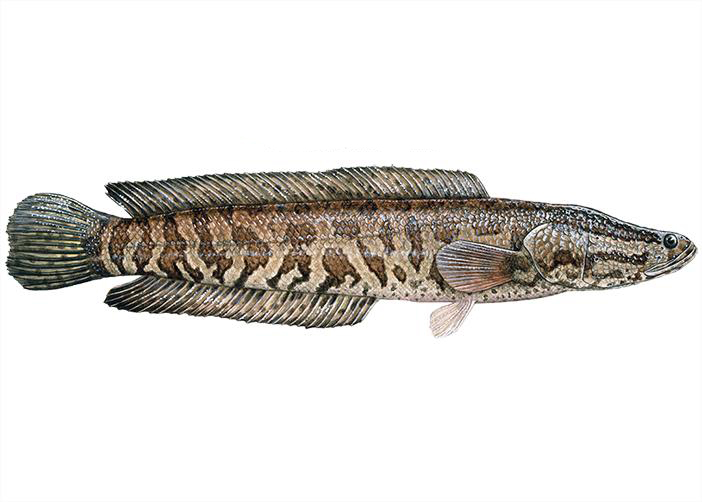
Snakeheads are one of the rarest freshwater fish, so named because it looks very similar to a reptile. Snakefish are native to South and Central Asia. Although many people unsuccessfully fear its appearance, snakeheads are incredibly strong and very beautiful. As with all reptiles, there are more than 30 subspecies of cattle, varying in both size and color. Fishermen who have caught him at least once, note his fighting qualities and incredible ingenuity. And their gastronomic characteristics do not leave indifferent even the most sophisticated gourmets.
Content of the article:
- Snakehead description
- Snakehead Diversity
- Snakeheads Golden Cobra (Channa aurantimaculata)
- Red snakeheads (Channa micropeltes)
- Dwarf Snakeheads (Channa gachua)
- Imperial snakeheads (Channa marulioides)
- Rainbow serpent (Channa bleheri)
- Змееголов Банка (Channa bankanensis)
- Glazed snakeheads (Channa pleurophthalma)
- Spotted snakeheads (Channa punctata)
- African snakehead (Parachanna obscura)
- Dimensions of fish
- Nerest
- Habitat
- What does snakeheads eat?
- Snakehead Cases
- What to catch snakeheads
- Snake dish – recipes with photo
Snakehead Description
Paradise has a muscular body with a flat head and wide open eyes, like a snake. Small scaly plates of the fish body are covered with mucus. A large, slightly sloping down mouth has powerful jaws with many sharp small teeth. In childhood, snakeheads are very similar to snakes, and even experienced fishermen can not always immediately distinguish a small fish from a small snake. The tail is small and round, and the dorsal fin runs along the entire body of the fish from the head to the tip of the tail. Adult fish have a greenish-brown body with dark stripes on the sides and back. Life is white.
The color of the linkod changes as it grows: the red-orange stripes on the young body become darker as they grow older.

The fish’s unique respiratory system allows it to breathe the atmosphere, which gives it incredible vitality. In addition to the gills, the fish has a breathing sac located above the gills. This peculiarity of the structure of the airways causes the snakehead to swim on the surface of the body of water from time to time to breathe air. At this point, they are reminiscent of pigeons.
Thanks to its powerful body and unique respiratory system, snakeheads can move across land to neighboring bodies of water, overcoming distances of several kilometers and remaining on waterless land for up to five days. During drying, snakeheads can build small chambers about 80 cm deep in the sandy bottom of dry bodies of water, lubricate them from the inside with mucus and remain suspended until the excavated chambers are filled with water.
Snakeheads winter in small groups of 8-10 individuals in caves near steep shores.
Snakehead Diversity
Snakeheads Golden Cobra (Channa aurantimaculata)
Or, in other words, this type of fish is called orange-spotted. Predators can grow up to 40 cm, and since the golden cobra has an aggressive behavior, separate breeding is recommended. They feel comfortable in water with an optimal average temperature of 23°C. The water should be medium in hardness and close to neutral acidity. Individuals of this species migrate further along the reservoir from India, where they find comfortable conditions.

Red snakeheads (Channa micropeltes)
Predators of this species are also known as giant snakeheads. Many of them easily reach 1 m even in captivity. The red snakehead is the largest representative of its kind. In addition to size, the red snakehead is considered the most aggressive of its peers. Neighboring aquariums are subject to its attack, even if they belong to the same species. He also attacks neighbors larger than himself, and his attacks do not depend on the presence of hunger.
Channa Micropeltes have the sharpest teeth of any species. Aquarius must be careful not to attack their hands. On the body of the young predator there are orange stripes that fold into an interesting pattern, over time acquiring a pale blue hue that disappears. The Red Snake does not impose special requirements on the composition of water, but due to its pleasant habitat, it is suitable for an average temperature of 27 ° C. This type is easier to cope with an experienced aquarist.
Dwarf Snakeheads (Channa gachua)
A common type of serpentine rock. It is included in the complex of species and designated as dwarf. According to some experts, the complex is related to the population of C. limbata, which lives in Southeast Asia. Channa Gachua should live in soft water with an average temperature of 22°C. This is an almost neutral level of acidity, and this indicator is best suited for this habitat.
In length predators can grow up to 20 cm. Due to their size, d-star snakes are usually larger than other fish species in the same aquarium.
Imperial snakeheads (Channa marulioides)
Since predators of this species grow up to 65 cm in length, they are either suitable for living only in different aquariums, or they are allowed to be shared with very large neighbors. In both cases, a huge aquarium with an average temperature of 26 ° C is required. The water should be soft or moderately hard and the acidity level of the water should be neutral.
Rainbow serpent (Channa bleheri)
d This predator from the star snake complex is not very aggressive. Individuals grow up to 20 cm in length and have a bright color. The most colorful of snakes. Like Channa Gachua, it can live in cold water aquariums.
Zmeeegolov Bank (Channa bankanensis)
Individuals of this species require a habitat. Channa Bankanensis lives in water with an acidity level of up to 2.8. It is a very acidic environment. Aquariums should maintain the required level of acidity without becoming neutral and, most importantly, without making fish more susceptible to infections.
Despite its small size, Zmeegolov Bank is aggressive. Representatives can grow up to 23 cm in length. Due to the peculiarities of their habitat, individual single-leaf aquariums should be selected.
Channa pleurophthalma
The glass snake from Southeast Asia is considered one of the most attractive in appearance. In fact, its body shape differs from other canides with cylindrical bodies. And Channa Pleurophthalma has a laterally compressed body. This feature has been identified by some experts when choosing fish.
In the wild, snake-eyes live in dark waters with an acidic environment, but close to neutral levels. In artificial conditions, it can adapt to water with a neutral index of 26°C with a comfortable average temperature of the neutral index, but it needs water. With average stiffness. Predators grow up to 45 cm and usually coexist with other larger species due to their relatively peaceful nature.
Spotted snakeheads (Channa punctata)
Channa Punctata is widespread in Indian waters. It can comfortably exist in a variety of conditions, ranging from moderate latitudes to the tropics. Therefore, it is not particularly demanding to a certain water composition and easily tolerates temperatures from 9°C to 40°C. Views are aggressive. The father is small in size, reaching 30 cm in length. His unpretentiousness is impressive when choosing, but aggressiveness is pushed to the background.
African snakehead (Parachanna obscura)
Externally


