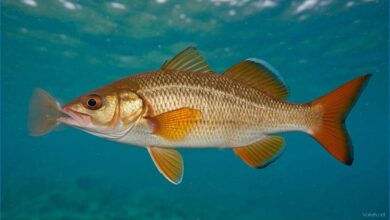
Crucian carp – description and photo

Karas is one of the most popular varieties of fish belonging to the order of carp, the class of striped fins and the family of carps. It has a slightly rounded, slightly elongated body with slightly flattened sides, covered with a smooth large scal. The color of the fish has a golden or silver hue, depending on the type of fish.
Content of the article:
The spine is very thick and contains sharp toothed rays, as well as high spinal fins and buttocks. The head is small compared to the body, the eyes are small, and the mouth has one row of esophageal teeth.
The average weight reaches 1-2 kg, but there are trophy specimens of the golden penalty weighing up to 4 kg, reaching 50-60 cm in length and with an average life expectancy of 8-12 years.
Nerest
The germination period begins in late May – early June and depends entirely on the water temperature. Silver carp, although it belongs to carp, is less water-prone and the optimal temperature for breeding should reach 20°C. In open areas of small bodies of water (small ponds, lakes) the water warms faster, respectively, and germination occurs earlier than in larger bodies of water in low-lying areas.
In mid-May, the punishment is collected in a room near the coastal areas of reservoirs, with a number of up to 100 individuals, and is directed to the stones. The favorite habitat is reed growths, while the rest of the aquatic vegetation is sidelined.
Nesting occurs mostly in the morning, the warmer the water, the faster the process, and the ejected caviar (often from 100,000 to 150,000) sticks to the plants, sticky and yellowish in color. The peculiarity of the mating process in the cockroach is its ability to spawn throughout the summer, although subsequent spawning occurs less and less intensely.
Habitats
Karas is one of the most unpretentious fish, common in both swampy shallow water bodies and large rivers with running lakes. They adapt to the low levels of oxygen in the water that other fish cannot tolerate.

It can also withstand very low temperatures, literally crawling into the ice and surviving in it until it begins to melt. However, in most cases, when dried or frozen, it bursts into the trough, where it successfully waits for a negative period.
Preferred habitats are warm stagnant or marshy bodies of water with medium depth and aquatic vegetation. Karasa can be found in the bottom layers of water with a loose ilious bottom, it actively seeks food in semi-decomposed organic matter. However, karachi is a non-constant fish, and atmospheric pressure and weather conditions can affect the feeding activity and movement of fish in different layers of water.
Calendar clove punished
———+++++++++++————
| Jan. | February. | March | Apr. | May | June | July | August | September | October. | New. | Dec. |
Jan.The fish is in the middle of winterFebruary.Does not bite. The fish move slowly and are mostly asleep.MarchWith the arrival of spring, the claw is active, but the claw is weakApr.Fish activity is slightly better than in March.MayKaras actively seeks food and can crawl in warmer areas of the reservoirJuneIn the period of germination glue successful, but unpredictableJulyMonth of maximum catch, especially in the morningAugustBite unstable, with fallSeptemberActive fishing is possible on warm sunny days. In colder weather, fishing is reduced.October.In cold weather, fish move from shallow to deep.New.Karas begins to sink into the river, waiting for the arrival of winter daysDec.Winter One-eyed fish, almost “deaf” everywhere in Clen
Search places hunt

Winter time.
With the onset of winter days, the fish adheres to the tribal zone and rows holes at the bottom of the orcs, larger individuals are near the shrubs of re and re, as well as near the gaps of the depths. The best time for fishing is mild sunny days, with severe frost or snowfall the fish will be kept deep and fishing will be useless.
Spring season.
With the warming of the water temperature, the activity of maple increases significantly, the fish rises from the depth and is caught near the aquatic vegetation, preferring lead and lead in fairly small, well-colored bodies of water.
Summer time.
After spawning, the fever begins, as the fish actively absorbs the mass and recovers. Fishing is most successful during this period. On hot summer days, it moves around the reservoir in search of cooler places. The best places to look for karachi are dense coastal shrubs and dark areas with hanging leaves.
Autumn period.
When the temperature drops, the bark leaves the shallow water and moves to deeper places where heat is still retained. Fishing in small reservoirs is ineffective as they simply go into the trough because it is a quiet place. Successful fishing in large reservoirs requires the search for fish accumulations in bottom pits. In addition, cool conditions are the presence of small winds and small warm rains.
Attractions
Life:
– Butterflies, microorganisms, worms;
Vegetables:
Special:
– Crumbs, dough, crackers, breadcrumbs, steamed cream (oatmeal, wheat, noodles, pearls, corn) There are cereals.
Taste:
– Syrup, hemp and aniseed.
Ways to catch
Floating rods are the most popular way of fishing, and no rod is too long for fishing, so maple is an underwater shrub.
Right – There is a large number of hooks, 5 or more. This allows you to use a variety of baits and increases the chances of successful fishing. Fishing signals are bells or pieces of mud attached to the Luska.
Springs or nipples are primarily designed to completely swallow the bait by crows, so the hooks are hidden in the bait and placed on various feedstocks.
Feeders are the newest method of bottom fishing and involve the use of a feed trap with a diameter of 0.16-0.18 mm, weighing 40 g. The length of the rod in this case is 3-3.5 m. The bite is recorded on the flexible end of the rod.